By: Robert Prince, PT, DPT, ATC/L, CSCS
You’re sprinting on your typical route, and everything feels great. Then suddenly, you feel a grab at the back of your thigh that makes you drop mid-stride. What do you do next?
This exact scenario happens often, and hamstring strains are one of the most common injuries I treat as a sports physical therapist. I want to walk through what’s actually happening in the muscle when a strain occurs, what rehab looks like from day one, and how I help athletes get all the way back to competing, not just back to running.
What Is a Hamstring Strain?
A hamstring injury usually occurs on an eccentric movement of the hamstring, which typically happens when you’re running. It can also happen from overexerting or overstretching your stride. It can happen to anyone from runners, to basketball players, to cyclists, to dancers.
There are usually three spots where it happens. One is towards the knee, more in the tendon. Another is more of a mid-belly injury to the hamstring itself. And one is up by your glute, where the hamstring originates.
It’s Not Just a Sports Injury
Hamstring strains aren’t limited to the field or track. Heavy lifting in general can cause the same injury. Anytime you’re loading the hamstring in that stretched, bent-over position, your risk increases.
The Different Grades of Hamstring Strains
Hamstring strains are primarily nonsurgical. Injuries are generally categorized into grades, one through three, though the exact classification depends on which literature you’re reading. Generally speaking:
- Grade 1 is a mild strain, with a small amount of separation in the muscle fibers. You can usually still do quite a bit of activity, though you may notice some mild soreness or bruising.
- Grade 2 involves more separation than a Grade 1, along with swelling, bruising, and pain. This grade tends to be the most painful and will moderately limit your activity level.
- Grade 3 is a complete tear of the muscle, with significant swelling and bruising. Interestingly, this level isn’t always the most painful in the days after, since nerve endings tear along with the muscle fibers.
If you feel the “pop” or “grab” at the back of your thigh at practice or a game, immediately go see your athletic trainer, when available. They are the first line of defense when it comes to injuries and treatment on the spot. From there, it is important to see a physical therapist. Depending on the state you live in, you may not need a referral to see a physical therapist. Arizona and Texas are direct access states, which you can learn more about here: (link direct access blog)
In a lot of cases, hamstring strains don’t require surgery and physical therapy is the best approach to getting you back to sport.
What To Expect at Physical Therapy
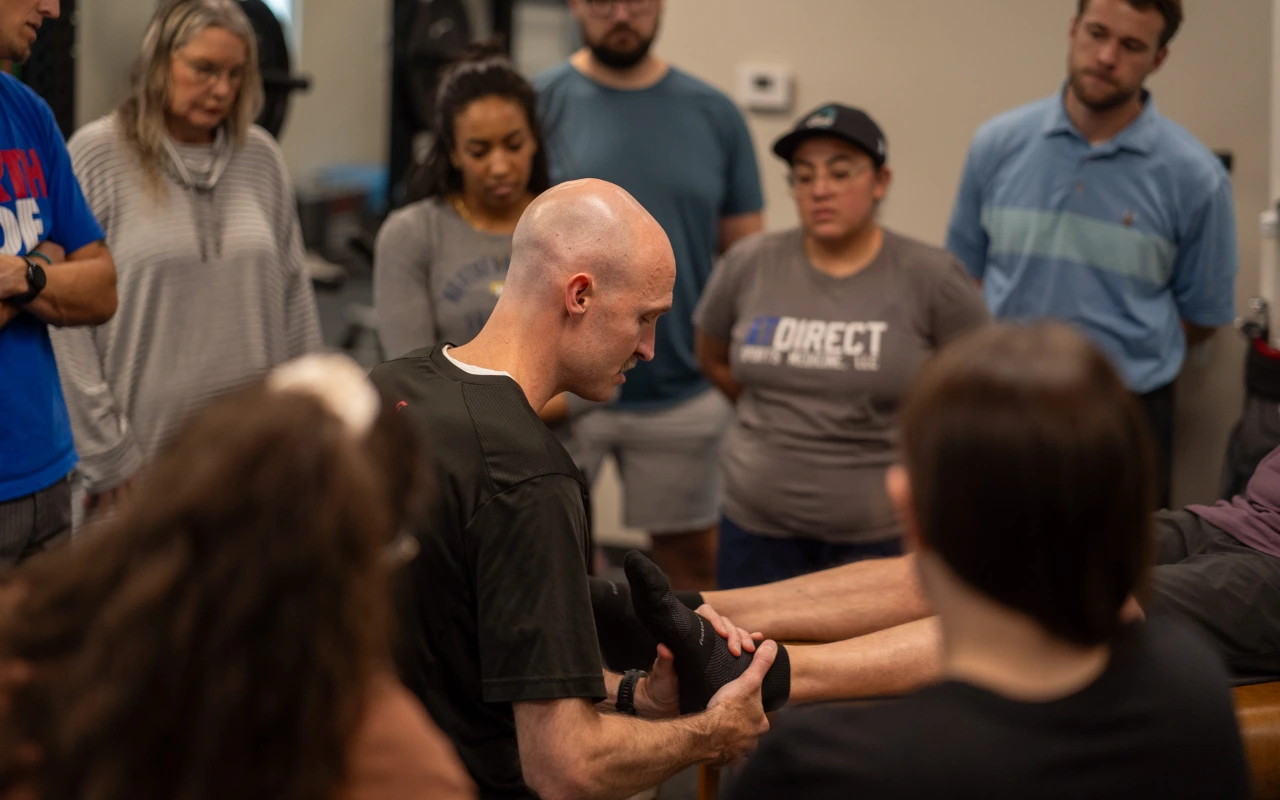
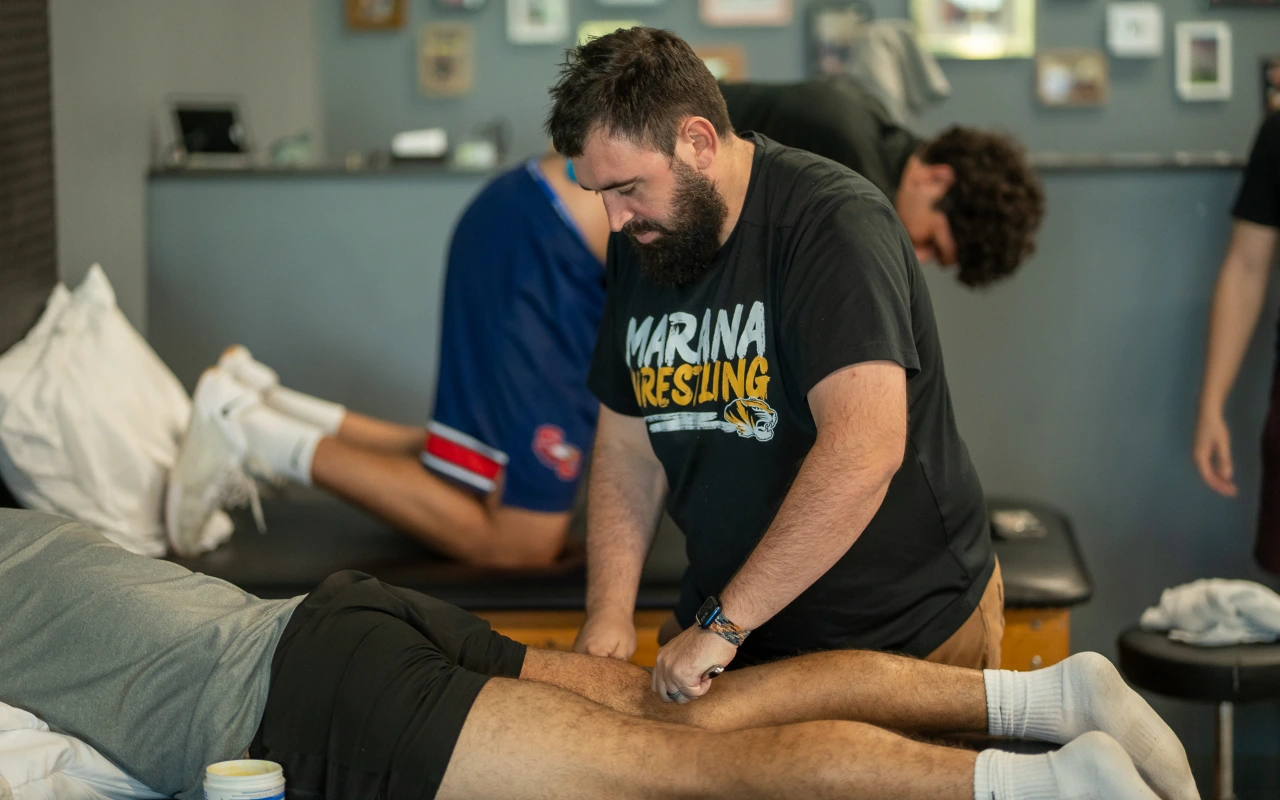
Day one is usually the toughest, just from the evaluation itself. I start by finding the area that’s tender to palpation and measuring it, both widthwise and lengthwise, and noting any discoloration. It’s not a comfortable process, because I’m checking when the pain stops and how far it spreads.
From there, I look at range of motion. For athletes, that means more than a basic straight leg raise, since they need to move in an athletic position. I check how far someone can bring their hip into flexion and how far they can bring their knee into active extension, since the hamstring is a two-joint muscle that crosses both the hip and the knee.
Next comes strength testing with a dynamometer, comparing the injured side to the uninjured side at different angles. Then, we check gait. Is walking painful? Does stride length need to be adjusted? If the injury is higher up toward the hip, I’ll usually decrease the walking stride a bit. If it’s closer to the knee, it’s more about how much knee flexion someone can use without affecting the walk.
There’s research out there with equations you can plug numbers into that spit out an estimated return-to-play timeline, but honestly, it’s just not that accurate. What actually guides rehab is all of these individual data points together.
Return to Sport vs. Return to Performance
Clearing someone depends on what you mean by return to sport versus return to performance, because those aren’t the same thing.
For return to sport, I think about when an athlete can start their return-to-run progression, and where they’re at. If they’re also being managed by an athletic trainer, we work together to guide that progression. I have to think about the athlete’s typical volume: are they mainly a sprinter, a baseball player, a football player, a soccer player? Do they run in a straight line, or do they have to cut and curve running bases or playing a field sport? I take their total volume and work backward from there, since running is a great exercise for the hamstring.
But being ready to run doesn’t mean you’re ready to perform. You get deconditioned fast if you haven’t kept up sport-specific conditioning, since running and conditioning rely on different metabolic pathways. Are you caught up on plays? Have you kept up with film? Can you still handle dual tasking, like reacting if someone steps in front of you, cutting left or right, or adjusting a kick or a pass? Track tends to be a little more straightforward, since it’s usually just running in a straight line and those variables aren’t as present.
But my job as your sports physical therapist is to make sure you are going through the proper progressions to get you ready to return to performance safely.
Lowering the Risk of Re-Injury
One of the biggest risk factors for a hamstring injury is having had one before. If you’ve strained your hamstring once, you’re more susceptible to another, whether in the same leg or the opposite one.
Before I clear someone from rehab, I want to see a leg strength asymmetry under 5%, measured with a dynamometer in different positions. I also recommend building a hamstring maintenance program into your routine long after rehab ends. Nordic hamstring curls have been shown to be effective here, since they train the hamstrings in that same eccentric pattern that so often causes the initial injury. Maintaining regular maximal-effort sprints, roughly twice a week when possible, has also been shown to support hamstring health and help reduce re-tear rates.
Getting Back to What You Love
A hamstring strain can be frustrating, especially for athletes who just want to get back on the field. But rehab isn’t just about getting you running again. It’s about making sure you’re ready to compete at the level you were before, and reducing the chances you’ll end up back here again.