By Rebekah Hibbert, Spooner Director of Sports Medicine
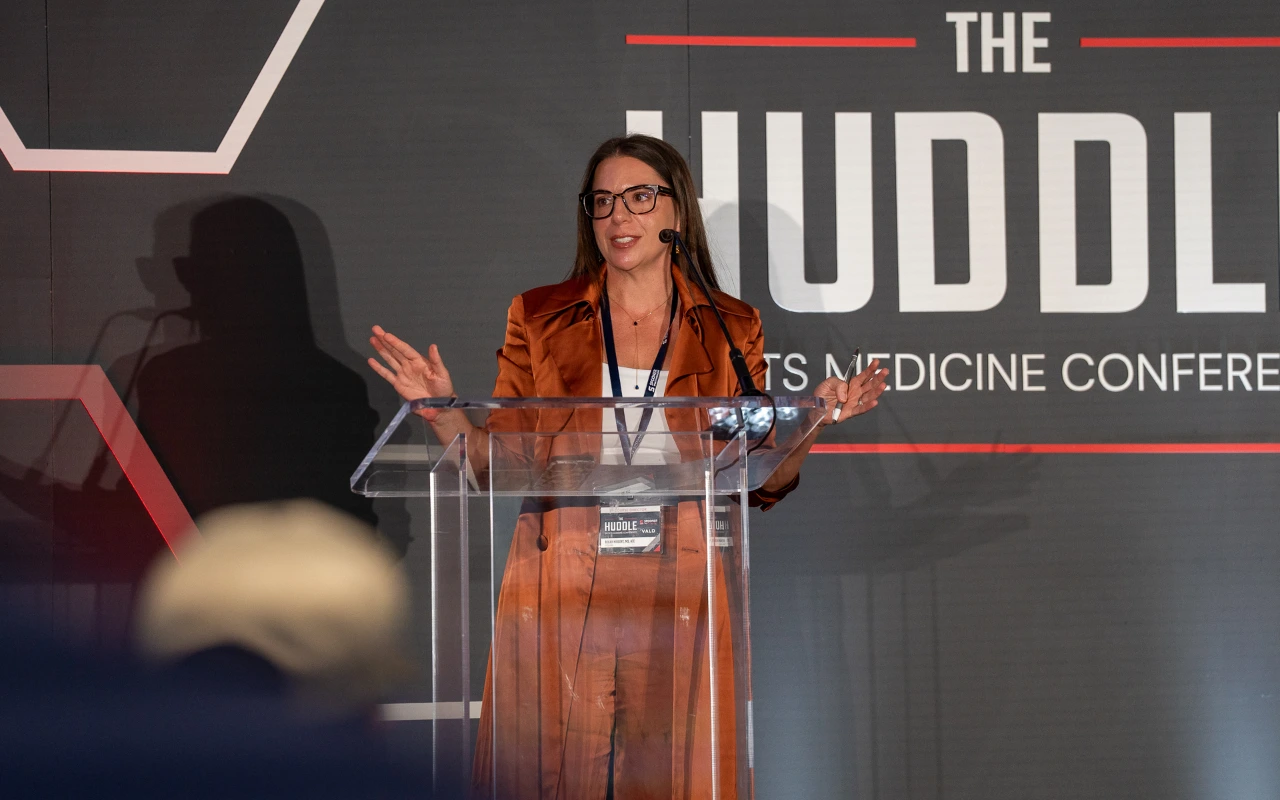
The following is an excerpt from a lecture by Rebekah Hibbert, Director of Sports Medicine at Spooner, presented at The Huddle 2026 Online. Access the full session by purchasing The Virtual Huddle on our website to earn 14 CEUs.
What Can Burnout Look Like?
Let me take you back to where I was. I was 30 years old, the only Athletic Trainer at a Division III college, responsible for 16 sports, with every outdoor team practicing off campus. I was making $36,000 a year and regularly going weeks to months without a single day off. My job had become all-consuming. There was little time for family, friends, or anything outside of work, and I was running on empty. What I didn’t realize at the time was that I was experiencing burnout.
The World Health Organization defines burnout as a work-related syndrome resulting from chronic workplace stress that has not been successfully managed. It typically presents in three ways: overwhelming exhaustion, increasing cynicism or detachment, and a reduced sense of professional effectiveness.
For those of us in sports medicine, the conditions for burnout are often built into our jobs. We work in an athlete-first culture where outcomes are measured by injuries and return-to-play timelines. We answer late-night calls and texts, travel on weekends, and adapt to constantly changing schedules. Over time, those demands blur the boundaries between work and life, making burnout feel less like an exception and more like part of the job.
Burnout Starts with Identity
Many of us enter sports medicine because we want to help athletes be their best. Somewhere along the way, though, our profession can slowly become our identity if we aren’t careful. We begin to believe that being valuable means being available. We convince ourselves that no one else can do what we do, or that asking for help somehow diminishes our worth.
I know that mindset because I lived it. When I was burning out, no one could ever question how hard I worked. I wanted to prove my value by being everything to everyone. So, I said yes to every opportunity, every athlete, every responsibility, leaving very little for myself.
When our professional identity becomes our entire identity, boundaries don’t just become difficult, they can become impossible.
Boundaries Are a Professional Skill
The problem isn’t that we don’t know boundaries are important. The problem is that most of us were never taught how to develop them.
In reality, boundaries are one of the most important professional skills we can develop. We would never expect our athletes to perform at a high level without recovery, yet many of us expect exactly that from ourselves. Boundaries create the space to recover, reset, and continue showing up with purpose, for our athletes, our teams, and the people we love. They don’t protect short-term comfort; they protect long-term sustainability.
Preview the The Resilience Shift: Redefining Success, Relationships, and Professional Identity session from The Virtual Huddle
You Weren’t Meant to Do This Alone
One of the biggest misconceptions in sports medicine is that great clinicians do everything themselves.
Many of us were trained in environments where autonomy was viewed as competence. As a result, collaboration can feel like giving work away instead of strengthening athlete care.
But collaboration isn’t passing off responsibility, it’s taking care of the athlete at the highest level possible.
Effective collaboration requires clear communication, mutual visibility, and what I call disciplined humility: knowing when you’re primary source of care versus when you’re a valuable resource to get the athlete where they need to go. Collaboration doesn’t reduce ownership. It creates clearer ownership while distributing the workload in healthier, more sustainable ways.
Resilience Does Not Equal Endurance
One of the greatest ironies in sports medicine is that we constantly teach our athletes the importance of recovery, yet we often deny ourselves that same opportunity.
Too often we confuse resilience with endurance. Endurance is absorbing stress and simply pushing through. In reality, resilience is the ability to adapt, recover, and continue moving forward in way that is healthier for us.
Resilience also isn’t something we build alone. It comes from having a resilience network: a system of people, resources, and routines that support us when work becomes difficult. That network may include mentors, trusted colleagues, interdisciplinary partners, realistic schedules, clear role expectations, recovery habits, and the relationships outside of work that remind us who we are beyond our profession.
Resilience isn’t built by tolerating more stress. It’s built by creating systems that help us recover from it.
Learn more about creating a resilience network, sign up for The Vitual Huddle
Redefining Success
Perhaps the biggest shift we need to make is redefining what success actually looks like.
Success isn’t martyrdom. Something I learned the hard way. I didn’t have to sacrifice all of myself to work in order to be successful.
One of the best pieces of advice I have ever received was this: Don’t do so much that people begin to believe you don’t need help.
Think about that for a minute. If you’re always the one saying yes, covering every event, solving every problem, and never asking for help, people begin to assume you don’t need it. That expectation doesn’t just come from others; it becomes one we place on ourselves.
That’s why it’s important to remember that everything you’re passionate about shouldn’t be tied to your profession. Your job is something you do, it’s not everything you are.
Let me be very clear, nobody chooses burnout. But many of us unintentionally reinforce the systems that create it by over-functioning, staying silent, and equating self-sacrifice with value.
Burnout doesn’t have to mean the end of your career. Sometimes it’s the moment that forces you to step back and ask yourself a different question: How do I build a career that I can sustain? Growth isn’t always about doing more. It’s about being intentional with where you invest your time, energy, and attention. Sometimes that means adjusting, resetting, asking for help, setting boundaries, and reconnecting with who you are both inside and outside of your profession.
Learning to care for yourself isn’t selfish, it’s what allows you to continue caring for everyone else. Burnout doesn’t have to be the price of working in sports medicine. With the right mindset, strategies, and support systems, you can build a career that is both meaningful and sustainable. Because we need you in sports medicine, but we need you healthy enough to stay in it.